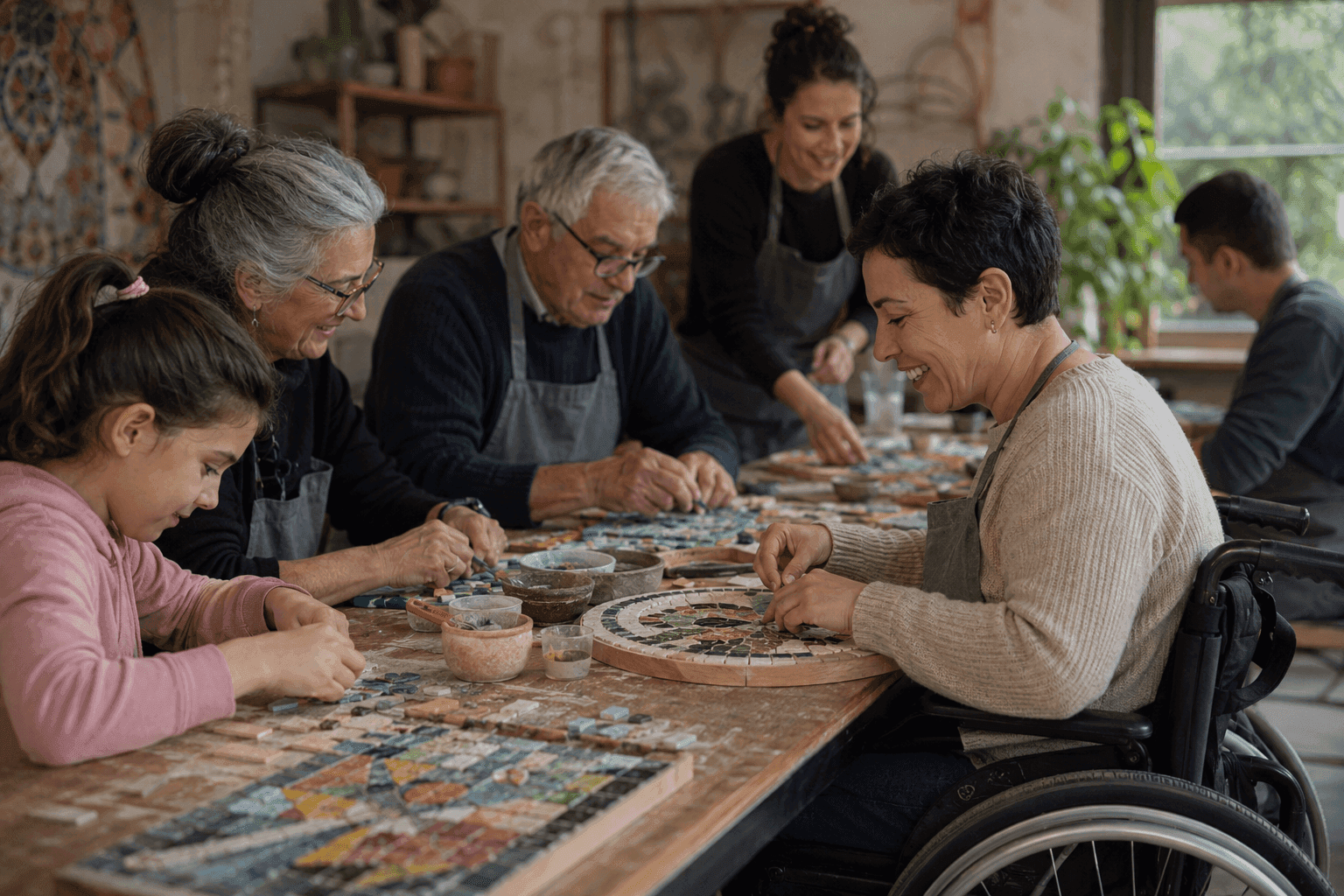
When we picture a workshop, we often imagine an 'average' participant: an adult, in good health, with steady hands. But the real audience is more varied. There are people with a few more years and less steady hands, people with a motor or sensory difficulty, people who are simply slower. Making your workshop accessible isn't just an act of care: it's a concrete way to widen your audience and, often, to improve the experience for everyone.
There's also a misconception to clear up: accessibility doesn't only mean disability or wheelchair ramps. It means thinking about the real variety of people — the older guest, the child, the person who doesn't speak the language well, the one who's simply slower or unsure. And every adjustment that makes the experience easier for someone with a particular need almost always makes it more pleasant for everyone else too. It's an investment that widens your audience and raises quality in the same gesture.
Physical accessibility of the space
The first level concerns the space. Check whether your studio can be reached without stairs, whether there's room to move around with a companion, whether the tables are at a comfortable height even when seated. You can't always change the building, but you can be transparent: state the venue's features clearly on the workshop page, so everyone can decide for themselves.
Accessibility of the experience
- Allow for the option of working while seated for those who can't stand for long.
- Adapt the tools where you can: more comfortable grips, supports, alternatives to movements that require a lot of strength.
- Slow down and repeat: people with different paces need more time and explanations given without rushing.
- Welcome companions: for some people, having a family member or assistant present is what makes taking part possible at all.
Accessibility of communication
Speak clearly, look at people while you explain, alternate spoken explanation with visual demonstration: it helps those with hearing or comprehension difficulties. For participants from abroad, gestures and demonstrations are worth a thousand words. Simple language and a patient pace make the workshop better even for people with no particular needs.
Emotional accessibility: the invisible barrier
There's one form of accessibility that almost always gets forgotten: the emotional one. The same is true when you open up to families and children, an audience that, above all, wants to feel at ease. So many people don't sign up for a workshop not because of physical barriers, but because they think 'I'm no good at this, I'll embarrass myself'. Making the workshop emotionally accessible — by communicating that it's designed for complete beginners, that there's no judgement, that making mistakes is normal and part of the fun — knocks down the invisible barrier that stops more people than any step ever could. It's often the most effective way to genuinely widen your audience.
Domande frequenti
- Do I absolutely have to make my studio barrier-free?
- It's not always possible to alter the building, and no one is forcing you to. The key thing is to be transparent about the venue's features, so each person can assess in advance whether the experience suits them.
- How do I welcome a person with a disability without making them uncomfortable?
- Naturally: simply ask whether they need any adjustments, welcome any companion they bring, and adapt tools and timing without making a fuss about it. Discreet attention is worth more than emphatic gestures.
- Will accessibility make me lose time with the rest of the group?
- Almost never: clearer explanations, more patient pacing and more comfortable tools improve the experience for everyone. With a little organisation (seated stations, flexible activities) the group moves along smoothly.
- Do I need to specialise in workshops for people with disabilities?
- Not necessarily: you don't need to become an expert, you need an attitude of openness and flexibility. Ask the person what they need, adapt what you can and be transparent about the limits of your space. For very specific needs, listening to the person themselves is the best guide: they often know exactly what they need.
On Handsome you create your profile for free and describe your experience in detail, so everyone finds the workshop that's right for them.
Open your workshops to more people