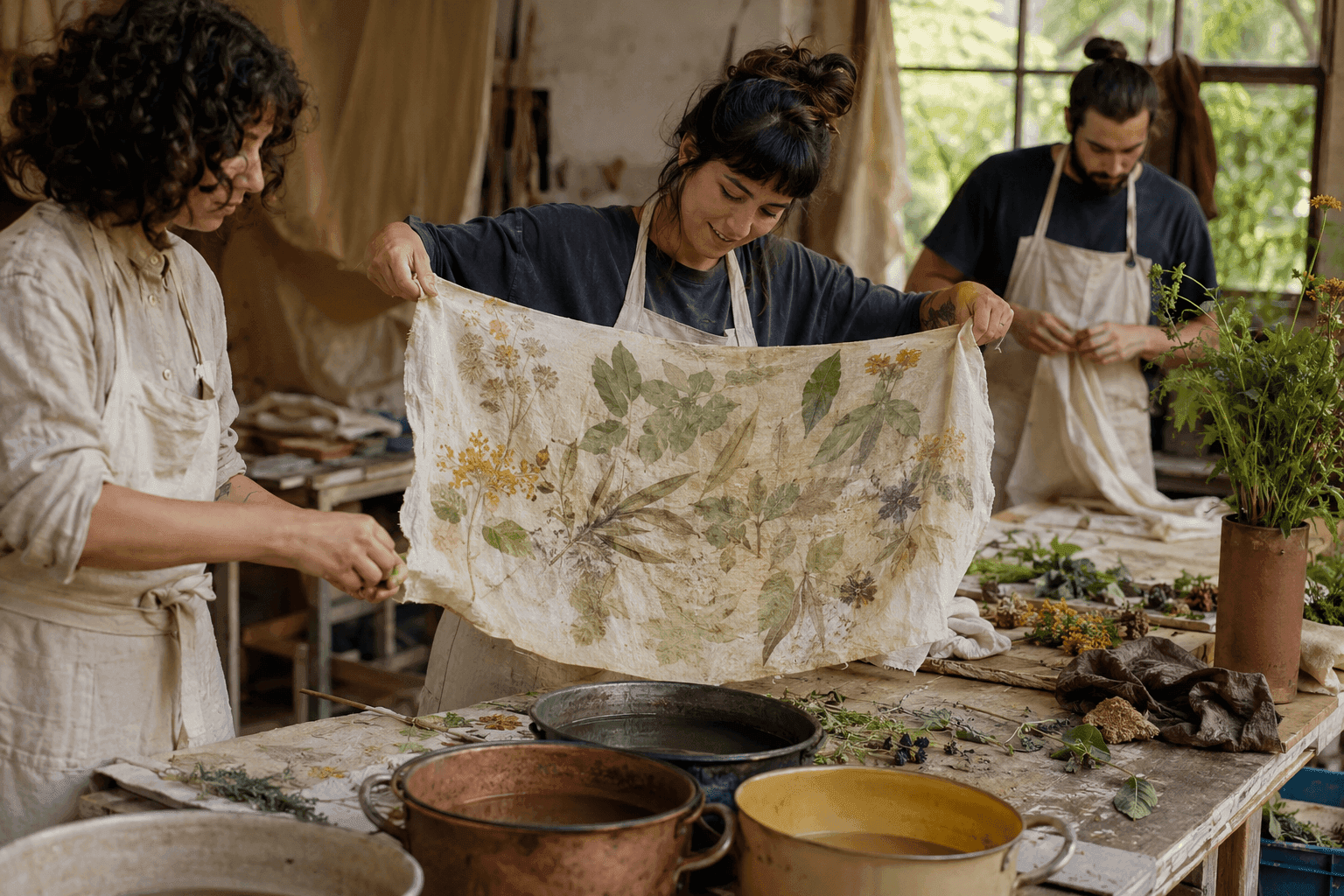
There's something almost magical about watching the shape of a leaf appear on a piece of fabric, or a ball of wool take on the color given by onion skins. Botanical printing (eco-printing) and natural dyeing bring together three things audiences love: creativity, contact with nature and sustainability. They're workshops that tell a story as well as producing a one-of-a-kind object.
It's also a craft perfectly in tune with the spirit of the times: in an age that cares about the environment and the handmade, dyeing with nature and giving new life to a piece of fabric speaks to a wide and growing audience. People who choose these workshops aren't just looking for a creative activity, but for a gesture that means something — ecological, authentic, far from industrial production. Highlighting this dimension makes the experience even more desirable.
Two crafts, one spirit
You can offer them together or separately. Eco-printing transfers the shape and pigment of leaves and flowers onto fabric, usually by steaming or boiling the rolled-up fabric (bundling). Natural dyeing colors fibers and fabrics using plants, roots, peels and plant scraps. Both share the same appeal: the result is never entirely predictable, and that's exactly what makes it special.
What to make
- A scarf or a foulard: a wide surface that shows off leaves and colors.
- Napkins or a tote bag: useful and perfect as a gift.
- A hand-dyed skein of wool or cotton: for people who knit or crochet.
- A small piece on paper: an option for those who prefer to work small.
Seasonality is your ally
A fascinating feature of these crafts is their bond with the seasons: the plants, flowers and leaves available change through the year, and with them the colors and shapes you can get. This isn't a limit but an opportunity: you can offer seasonal editions (the colors of autumn, the flowers of spring) that give people a reason to come back at different times, and tell the story of the link between the experience and nature's rhythm. Few workshops have such a natural hook into seasonality.
Turn unpredictability into value
The climax is opening the 'bundle' or pulling the fabric out of the dye bath: no one knows exactly how it will turn out. Instead of hiding it, make it the emotional heart of the experience: the anticipation, the surprise, the uniqueness of the result. Tell the sustainability story too — colors from nature, scraps that become a resource — because it's a value this audience actively seeks out.
Domande frequenti
- Are natural dyeing results reliable?
- They vary depending on plant, fiber, water and mordant: it's part of the charm, not a flaw. Make it clear from the start that every piece is unique and slightly unpredictable, so the unpredictability becomes value rather than disappointment.
- Do you need dangerous chemicals?
- Natural dyeing mostly uses plants and plant scraps; some mordants need to be handled carefully. Follow your suppliers' instructions, work in ventilated spaces and handle the more delicate steps yourself.
- Can I offer botanical printing and dyeing together?
- Yes, they share the same spirit and equipment and complement each other well. You can also keep them separate as two distinct workshops, or build a multi-session path for people who want to go deeper into both.
- Do you need a large space or special equipment?
- You need to be able to work with hot water and steam safely and with ventilation, but not an elaborate workshop. Many formats can be run with modest equipment. The most important thing is handling the hot steps and the mordants well, following your suppliers' instructions; the rest — fabrics, plants, dye materials — is relatively accessible.
Create your free profile and reach people looking for creative, natural and sustainable experiences.
Bring nature into your workshops on Handsome